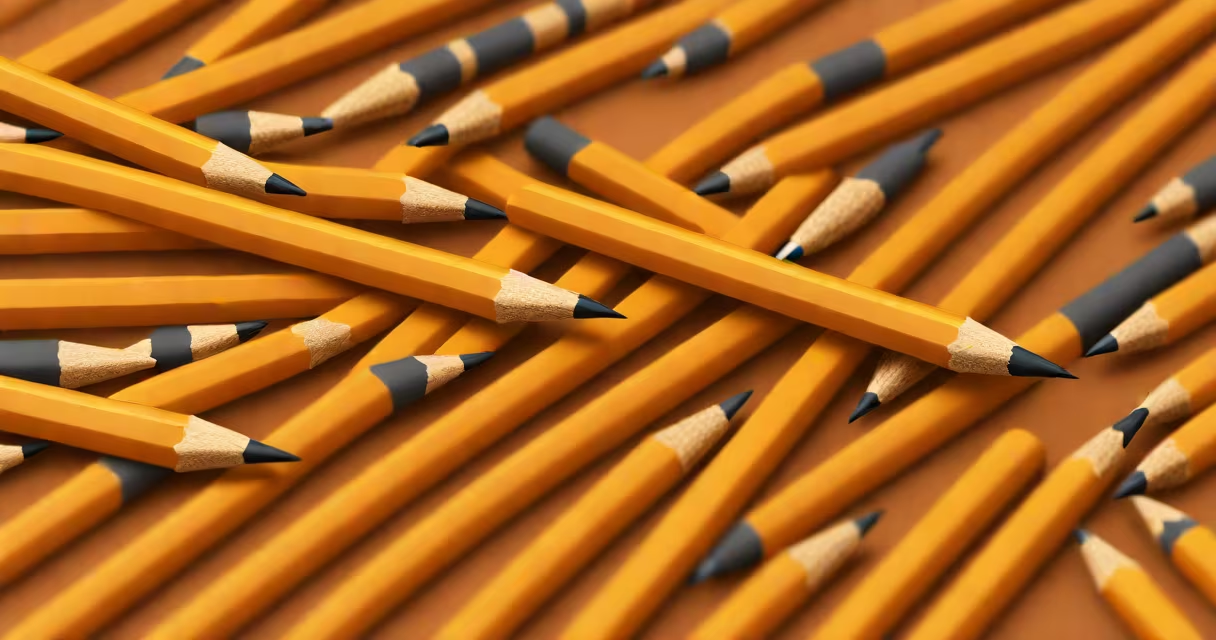
Pencils consist of a cylindrical wooden casing enclosing a graphite-clay core, topped with a rubber eraser and metal ferrule. The core is not lead-it's a mixture of graphite and clay, shaped and baked to achieve different hardness levels.
The core, often called "lead" in casual speech, is made by mixing powdered graphite with clay. The ratio determines the pencil's hardness: more clay makes it harder (lighter marks), less clay makes it softer (darker marks). This blend is extruded into thin rods, dried, and fired in ovens at temperatures exceeding 1,000°C. The resulting core is brittle and requires protection-hence the wooden casing.
Wooden pencils typically use cedar, especially Canadian or Western red cedar, valued for its fine grain, ease of sharpening, and resistance to splintering. The wood is cut into slats, grooved to hold the core, then glued together around the core. The outer layer is sanded and painted, usually with a lacquer finish. The eraser is attached via a metal ferrule, which clips the eraser to the pencil's end.
Graphite is a form of carbon, naturally occurring in mines such as those in Sri Lanka and China. It's ground into powder and mixed with clay in precise ratios. For example, a #2 pencil (standard for school tests) uses a mix of about 70% graphite and 30% clay. A #6 pencil, used for technical drawing, contains less graphite-around 40%-and more clay, making it harder and lighter.
Clay acts as a binder and controls the brittleness of the core. Too much graphite leads to smudging and breakage; too much clay results in weak writing performance. The mixture is pressed into molds, dried for up to 72 hours, then fired at 1,000-1,200°C. This process carbonizes the clay and strengthens the core.
A common misconception is that pencil "lead" is made of lead metal. It is not. Lead was historically used in early writing tools, but modern pencils have never contained lead. The term persists due to historical confusion. The American Chemical Society confirms that "pencil lead" is a misnomer-graphite is the actual material.
Most pencils use spruce or cedar. Cedar is preferred because it resists cracking during sharpening and holds color well. The wood is kiln-dried to reduce moisture content to below 8%. Slats are cut to 5/16 inch width and 7 inches long, then grooved with a precision router to fit the core.
Two slats are glued together with a water-resistant adhesive, forming a sandwich around the core. The assembly is clamped under pressure for 24 hours. After drying, the pencil is cut into individual units, then sanded and painted. The paint is typically a non-toxic, durable lacquer applied in multiple layers.
Some premium pencils use sustainably harvested wood. For example, Faber-Castell sources its wood from certified forests in Germany and Austria. The company reports that their production uses 98% recycled wood waste and 100% renewable energy in manufacturing.
The eraser is made from synthetic rubber or vinyl. Vinyl erasers are more durable and less likely to leave residue. They're produced by mixing polyvinyl chloride (PVC) with plasticizers and fillers like calcium carbonate. The mixture is extruded and vulcanized to improve elasticity.
The ferrule-the metal ring holding the eraser-is usually brass or aluminum. It's stamped from sheet metal, bent into shape, and soldered to the pencil. Some high-end pencils use gold-plated ferrules for aesthetic appeal.
Eraser quality varies. A standard eraser removes graphite cleanly but may wear down quickly. High-quality erasers, like those from Staedtler, use a blend of synthetic rubber and micro-fine abrasives to lift marks without damaging paper. These are rated for 10,000 strokes before replacement.
| Type | Core Material | Wood Type | Common Use |
|---|---|---|---|
| Standard #2 | Graphite (70%), clay (30%) | Western red cedar | School, standardized testing |
| Hard (H, 2H) | Graphite (40%), clay (60%) | Cedar or spruce | Technical drawing, engineering |
| Soft (B, 2B) | Graphite (80%), clay (20%) | Cedar | Art, sketching |
| Mechanical | Graphite/clay rod (1.0-2.0 mm) | Plastic or metal barrel | Office, drafting, precision work |
Contrary to popular belief, mechanical pencils do not use the same core as wooden pencils. Mechanical cores are thinner-typically 0.5 mm to 2.0 mm-and are manufactured using a continuous casting process. The core is fed through a spring-loaded mechanism, eliminating the need for sharpening.
Another misunderstanding is that all pencils are made the same way. Industrial manufacturers like Dixon Ticonderoga produce over 1 million pencils daily using automated lines. Each step-from wood cutting to painting-is monitored by sensors to ensure consistency. Handmade pencils, like those from Eberhard Faber, take longer but offer greater control over material quality and finish.
During the SAT and ACT exams, students must use #2 pencils. The College Board specifies that the graphite must be medium-hard, with a 70/30 graphite-to-clay ratio. This ensures consistent scanability by optical mark readers. A test score can be invalidated if the pencil mark is too light or too dark due to improper core hardness.
Manufacturers test each batch of #2 pencils by measuring the density of the mark on paper. A valid mark must register between 0.4 and 0.6 on a reflectance scale. Pencils that fall outside this range are rejected. This standard prevents errors in automated scoring systems.
For comparison, mechanical pencils are not accepted on most standardized tests because their marks are too uniform and lack the slight variation that scanning software expects. The physical act of pressing a wooden pencil creates subtle differences in ink distribution that help distinguish real human marks from machine-generated ones.
Many assume that pencil cores are made from lead ore. They are not. Graphite is mined from deposits in India, Brazil, and Madagascar. The largest known deposit is in Sri Lanka, where the mineral is extracted from metamorphic rock. The raw graphite is purified to remove impurities like iron and sulfur before being processed into pencil cores.
Another myth is that wooden pencils are biodegradable. While the wood and paint are natural, the lacquer and glue may contain synthetic additives. A 2021 study by the University of California, Berkeley, found that 63% of standard wooden pencils degrade fully within 18 months in soil, but 27% show incomplete breakdown due to synthetic coatings.
When choosing a pencil, consider the application. For art, a 4B pencil offers rich, dark lines. For math exams, a #2 pencil ensures readable scans. For drafting, a 2H pencil provides clean, sharp lines without smudging.
Understanding what pencils are made of reveals how a simple tool relies on precise chemistry and material science. The combination of graphite, clay, wood, and rubber creates a device used by billions annually.