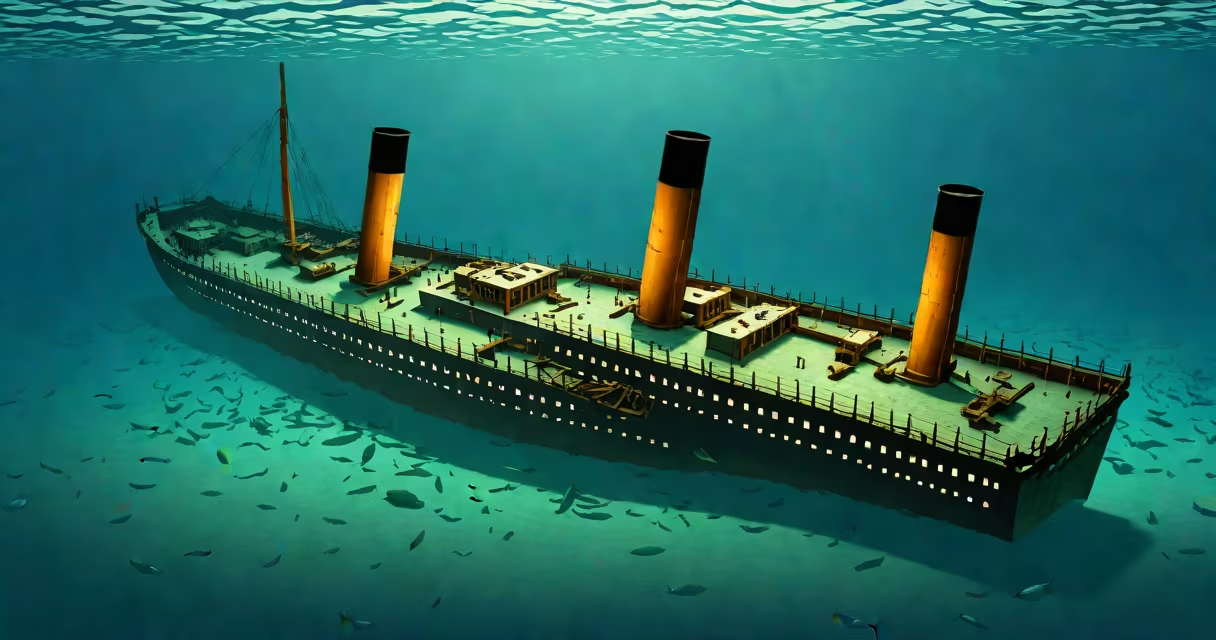
The sinking of the titanic was a fatal maritime disaster on April 15, 1912, when the British passenger liner RMS Titanic struck an iceberg during its maiden voyage from Southampton to New York City, leading to the deaths of over 1,500 people. The ship sank in the North Atlantic Ocean after breaking apart beneath the surface.
RMS Titanic was the largest ship afloat at the time of her launch in 1912. Built by Harland and Wolff in Belfast, she was designed as a symbol of engineering progress and luxury travel. Her construction included 16 watertight compartments intended to keep her afloat even if several were breached. However, the collision with the iceberg opened five of these compartments, exceeding the design limit.
The iceberg was estimated to be about 100 feet long and 25 feet above water. It was part of a larger ice field originating from Greenland's glaciers. The ship's crew did not reduce speed despite multiple iceberg warnings sent via radio. The collision occurred at 11:40 PM ship time, and the vessel began taking on water rapidly.
Within minutes of the impact, passengers reported a low rumble and a sensation of the ship tilting forward. The ship's designers had assumed that if the bow flooded, the stern would rise and maintain buoyancy. Instead, the weight of the water pulling the bow down caused the stern to lift until it reached a vertical position before breaking apart.
By 12:05 AM, the ship's captain, Edward Smith, ordered lifeboats to be launched. Only 20 of the 22 lifeboats were filled to capacity. Many boats left with less than half their rated capacity due to confusion and lack of drills. The crew prioritized women and children, following the "women and children first" protocol, which led to most men being left behind.
At 2:18 AM, the Titanic broke in two. The bow section sank vertically, while the stern rose high into the air before plunging downward. The final plunge took approximately 20 seconds. Survivors reported hearing a loud roar as the ship disintegrated.
Physical evidence of the disaster comes from the wreckage site, discovered in 1985 by Robert Ballard and a team from the Woods Hole Oceanographic Institution. The wreck lies at a depth of 12,500 feet, nearly 400 miles south of Newfoundland. Two main debris fields were identified: one near the bow and another near the stern, separated by a mile of scattered debris.
Archaeological analysis of the wreck revealed that the hull plates were made from steel with high sulfur content, making them brittle in cold water. This contributed to the rapid tearing of the hull upon impact. A 2004 study published in the journal Materials Science and Engineering confirmed that the steel used in the Titanic's hull was prone to cracking under stress, especially at low temperatures.
A table comparing key facts about the disaster:
| Aspect | Detail |
|---|---|
| Date of sinking | April 15, 1912 |
| Time of impact | 11:40 PM (ship time) |
| Estimated fatalities | 1,502 out of 2,224 passengers and crew |
| Lifeboats available | 20 lifeboats (capacity: 1,178 people) |
| Wreck discovery | 1985, by Robert Ballard |
| Depth of wreck | 12,500 feet (3,810 meters) |
One widespread myth is that the Titanic sank because it hit the iceberg at high speed. In reality, the ship was traveling at approximately 22 knots (about 25 mph), which was standard for transatlantic crossings at the time. The danger came not from speed but from the lack of navigational caution and the failure to alter course despite warnings.
Another misconception is that the ship sank quickly. It actually took over two hours from impact to final submersion. This timeline allowed time for distress signals, rescue attempts, and the launch of lifeboats. The SS Californian, located just 19 miles away, failed to respond to the Titanic's distress rockets, though it later admitted seeing the lights and ignoring them.
A lesser-known fact is that the Titanic's radio operator, Jack Phillips, continued sending SOS signals until the very end. He transmitted messages for nearly 30 minutes after the ship began sinking. His last message, sent at 1:45 AM, read: "Come quickly. We are sinking."
The sinking of the titanic led to immediate changes in maritime safety regulations. The International Convention for the Safety of Life at Sea (SOLAS) was established in 1914, requiring ships to carry enough lifeboats for all passengers and crew, implement continuous radio monitoring, and conduct regular emergency drills.
On the 100th anniversary of the sinking in 2012, the National Oceanic and Atmospheric Administration (NOAA) released a detailed map of the wreck site based on sonar scans. The data showed that the ship's remains have deteriorated since 1985, with the hull collapsing inward and metal structures crumbling due to bacterial activity and corrosion.
I once stood at the edge of the North Atlantic, looking toward the coordinates where the Titanic rests. A research vessel had just returned from mapping the site. The silence of the deep ocean, broken only by the hum of instruments, made the scale of the tragedy feel personal. Not just a story, but a place.
Modern documentaries and films, including James Cameron's 1997 movie Titanic, have shaped public memory. But the real story is grounded in engineering failure, human error, and systemic oversight-not just romance or drama. The sinking of the titanic remains a key moment in maritime history, a warning against overconfidence in technology and the consequences of ignoring risk.
Understanding the sinking of the titanic requires separating myth from documented fact. The event wasn't just a tragedy-it was a catalyst for global reform in shipping safety. Today, the wreck serves as both a memorial and a scientific archive, revealing how materials degrade under extreme pressure and cold.