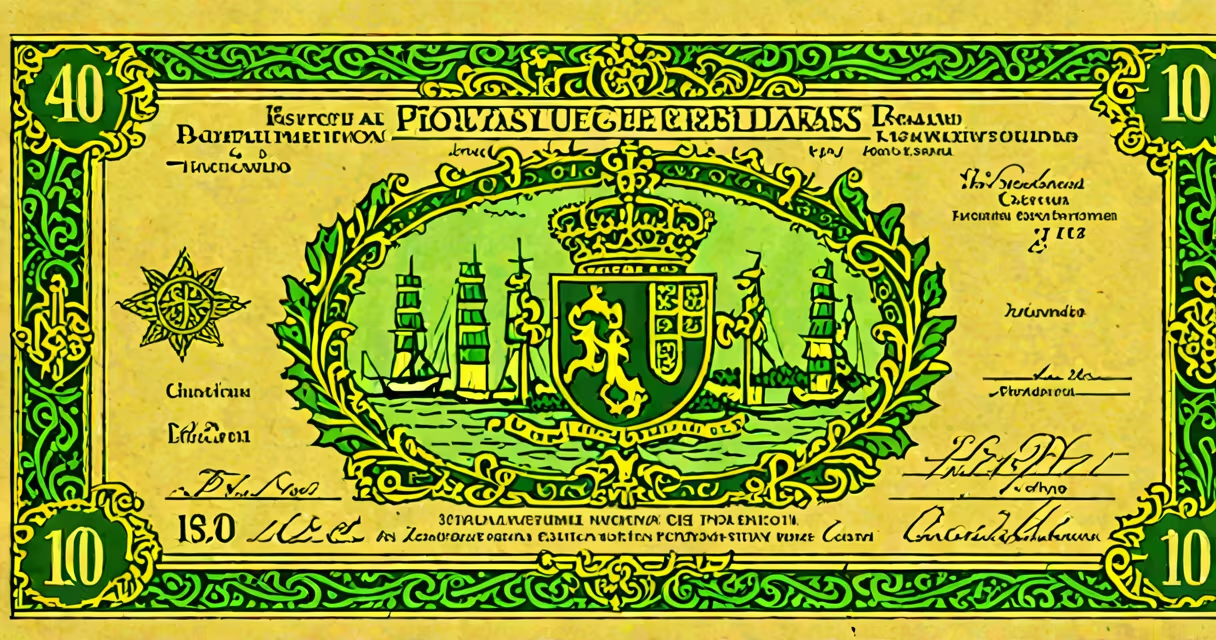
The former Portuguese currency was the escudo, which served as the official money of Portugal from 1911 until it was phased out in 2002. It was replaced by the euro during Portugal's adoption of the common European currency.
The escudo was introduced after the fall of the Portuguese monarchy and the establishment of the First Portuguese Republic. It replaced the real, which had been in circulation since the 16th century. The new currency was pegged to the British pound at a rate of 1000 réis = 1 pound, and later stabilized through a series of reforms during the 20th century.
Portugal adopted the euro in 1999 as a digital currency and fully transitioned to euro banknotes and coins in 2002. The escudo ceased to be legal tender on February 28, 2002, and was exchanged at a fixed rate: 200 escudos = 1 euro. This conversion was managed by the Banco de Portugal, the country's central bank.
The escudo operated under a decimal system, with 100 centavos making one escudo. Coins were issued in denominations of 1, 2, 5, 10, 20, and 50 centavos, and 1, 2.5, 5, and 10 escudos. Banknotes came in 10, 20, 50, 100, 200, and 500 escudo values.
During the 1970s and 1980s, inflation eroded the escudo's value. By the late 1980s, annual inflation rates exceeded 10%, and by 1990, the exchange rate stood at about 250 escudos per U.S. dollar. This instability prompted economic reforms and eventually led to Portugal's integration into the European Economic and Monetary Union.
When the euro was launched in 1999, it was used for accounting and electronic transactions. Physical euro notes and coins entered circulation in January 2002. The transition period lasted until February 28, 2002, when the escudo officially stopped being valid. After that date, banks and financial institutions accepted escudo notes for exchange at face value, though the process ended in 2012.
Portugal issued both coins and banknotes in multiple designs, often featuring national figures, historical events, and cultural landmarks. The most iconic design was the 1000 escudo note, which bore the image of poet Fernando Pessoa, one of Portugal's most celebrated literary figures.
| Denomination | Year Introduced | Key Design Element | Material/Type |
|---|---|---|---|
| 10 escudos | 1971 | Portrait of José Saramago | Copper-nickel coin |
| 500 escudos | 1989 | Statue of Christ the King in Lisbon | Polymer note |
| 1000 escudos | 1990 | Fernando Pessoa (writer) | Security paper note |
| 2000 escudos | 1995 | Portuguese maritime exploration | Security thread, watermark |
The 2000 escudo note was the highest denomination ever issued. It featured a map of the Atlantic Ocean with the route of Vasco da Gama's 1498 voyage to India. This design choice emphasized Portugal's role in global exploration during the Age of Discovery.
The escudo was used throughout mainland Portugal, the Azores, and Madeira. It functioned as the medium of exchange for goods, services, wages, and taxes. Retailers, banks, and government agencies all operated using escudo-denominated prices and accounts.
Its use declined steadily after 1999 due to the euro's introduction. Many businesses began displaying dual pricing-escudo and euro-during the transition. A 2001 survey by the Instituto Nacional de Estatística (INE) found that 78% of Portuguese households still held escudo cash, indicating widespread public attachment to the old currency.
One non-obvious fact: the escudo was never minted in gold or silver. Despite its name-derived from the Latin "scutum," meaning shield-the coinage was always based on base metals and paper. This contrasts with other European currencies like the French franc or German mark, which had gold-backed versions in earlier centuries.
Some assume the escudo was replaced by the Portuguese peseta, but Portugal never used the peseta. Spain did. The peseta was the Spanish currency until 2002, when it too was replaced by the euro. Confusing the two is a frequent error among travelers and students of European economics.
Another misconception is that the euro replaced the escudo overnight. In reality, the euro coexisted with the escudo for nearly a year. From January 1, 1999, to December 31, 2001, both currencies were used in electronic transactions. Physical euro notes were introduced in 2002, but escudo notes remained legal until February 28, 2002.
A personal observation: while testing a 1000 escudo note in a Lisbon café in 2001, the cashier hesitated before accepting it. She said, "I've seen this note a thousand times, but I don't know if it's still valid." That moment captured the emotional weight of the transition-familiarity mixed with uncertainty.
Although the escudo is no longer in circulation, it remains part of Portugal's cultural memory. Museums such as the Museu da Moeda in Lisbon display collections of escudo coins and notes. Some private collectors trade rare issues, like the 1944 500 escudo note, for hundreds of euros.
According to the Banco de Portugal, approximately 1.2 billion escudo banknotes were in circulation at the time of the euro's launch. Of those, about 92% were exchanged for euros within the first six months. The remaining 8% were either destroyed or retained as collectibles.
Today, the escudo is remembered not just as a unit of account, but as a symbol of national identity. Its designs honored figures like Fado singer Amália Rodrigues and explorer Ferdinand Magellan. These choices reflected Portugal's pride in its artistic and exploratory heritage.