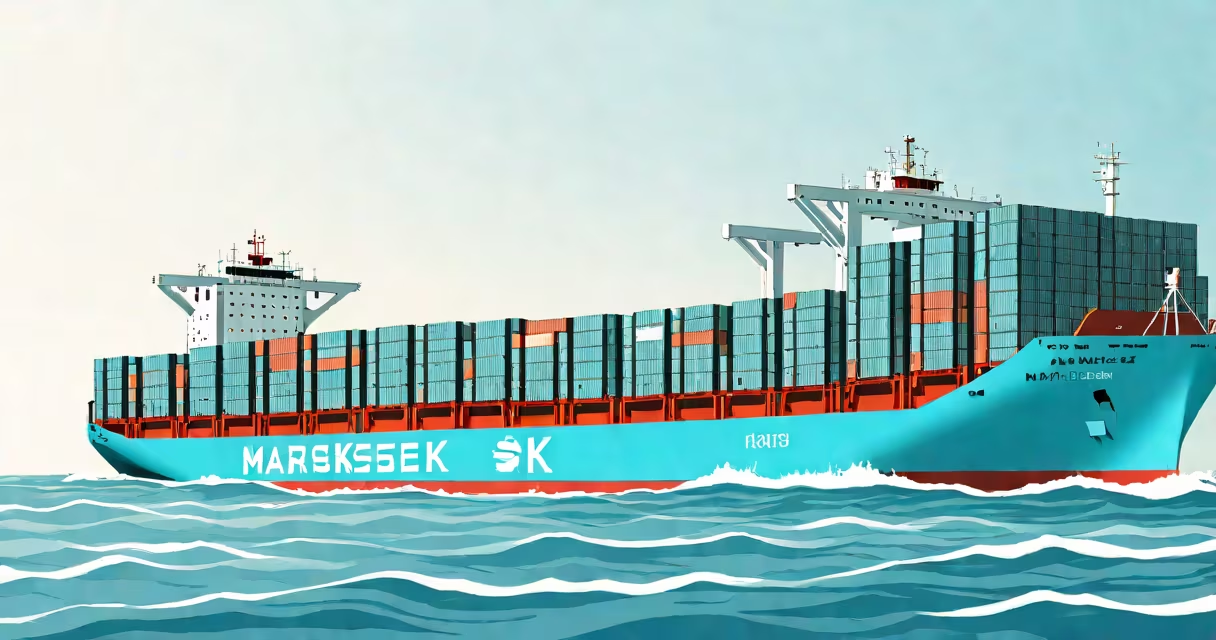
A Maersk ship is a large container vessel operated by Maersk Line, part of the A.P. Møller-Mærsk Group, designed to carry tens of thousands of standardized shipping containers across international trade routes. These vessels form the core of global supply chains, moving consumer goods, electronics, apparel, and industrial materials between continents.
Maersk ships are engineered for efficiency, reliability, and capacity. They operate on fixed schedules along major maritime corridors such as the Asia-Europe route, the trans-Pacific lane, and the North Atlantic trade axis. The company's fleet includes ultra-large container ships (ULCS) capable of carrying over 24,000 twenty-foot equivalent units (TEUs), with some newer models using dual-fuel engines to reduce emissions.
These vessels are not just transport tools-they are mobile logistics hubs. Each ship integrates advanced navigation systems, automated stowage planning software, and real-time tracking via satellite networks. Cargo is loaded and unloaded using massive gantry cranes at ports, with precise coordination between terminals, shipping lines, and customs authorities.
Maersk ships follow a structured operational cycle. After arriving at a port, they undergo a process called "berthing," where they dock alongside a terminal. A team of harbor pilots guides the vessel safely into position. Once secured, the ship's crew coordinates with terminal operators to begin unloading containers.
Each container is scanned upon arrival and departure. Data is uploaded to Maersk's digital platform, Maersk Connect, which provides real-time visibility to shippers and freight forwarders. This system reduces delays and improves inventory accuracy. For example, a shipment of 5,000 containers from Shanghai to Rotterdam may pass through five different ports, with updates sent every 15 minutes during transit.
During transit, the ship's captain and officers monitor weather, fuel consumption, and navigational hazards using electronic charts and radar. Modern Maersk vessels are equipped with automated ballast water management systems to prevent invasive species transfer-a requirement under the International Maritime Organization's Ballast Water Management Convention.
Maersk operates several distinct classes of container ships, each optimized for specific trade lanes and cargo volumes:
| Ship Class | Capacity (TEUs) | Primary Route | Key Features |
|---|---|---|---|
| Triple E-class | 18,000 | Asia-Europe | Energy-efficient design, dual-fuel capability, reduced CO₂ per container |
| MAERSK M class | 24,000+ | Trans-Pacific, Europe-Asia | Longest in Maersk fleet, uses LNG-ready engines, automated loading systems |
| Maersk Line feeder vessels | 1,500-3,000 | Regional distribution | Smaller, flexible routes between major hubs and regional ports |
The Triple E-class ships were introduced in 2013 and marked a shift toward sustainability. They use waste heat recovery systems to improve fuel efficiency by 20% compared to earlier models. According to Maersk's 2022 sustainability report, these ships emit 50% less CO₂ per TEU than older vessels.
Feeder ships serve as connectors between major ports and smaller regional hubs. For instance, a Maersk feeder vessel might transport containers from Singapore to Phuket, Thailand, then transfer them to a larger ship bound for Marseille. These vessels often have shorter turnaround times and higher frequency schedules.
Many people assume that "Maersk ship" refers only to the company's largest vessels. In reality, Maersk operates over 700 container ships globally, including smaller feeder and specialized vessels. The term applies to all ships under the Maersk brand, regardless of size or route.
Another misconception is that Maersk ships are exclusively owned by Maersk Line. While the company manages the fleet, many vessels are chartered or jointly operated through partnerships. For example, the Maersk Seaview, a 24,000-TEU vessel, was built under a joint agreement with Hyundai Heavy Industries and operates under Maersk's charter contract.
There's also confusion between Maersk and MSC (Mediterranean Shipping Company). Though both are major container lines, they are separate entities. Maersk is Danish-owned, while MSC is Swiss-based and privately held. The two companies compete on key trade routes but do not share fleets or operations. For example, the MSC Seaview ship is operated by MSC, not Maersk, despite the similar name.
Consider a typical voyage: a Maersk ship departs from the Port of Shenzhen, China, carrying 16,000 containers. The ship is a Triple E-class vessel, registered in Denmark, and flies the Danish flag. It sails westward through the South China Sea, past the Malacca Strait, across the Indian Ocean, and into the Suez Canal.
At the Suez Canal, the ship undergoes a mandatory inspection by Egyptian authorities. It passes through the canal in about 14 hours, paying a fee based on vessel size and cargo volume. After exiting into the Mediterranean, it continues north to the Port of Rotterdam, Netherlands.
Upon arrival, the ship's cargo is offloaded over four days. Each container is scanned, verified against the bill of lading, and routed to its final destination via rail or truck. The entire process takes 28 days, with daily updates sent to the sender via Maersk's digital tracking portal.
This process moves approximately $1.2 billion in goods annually, including electronics from Chinese factories, clothing from textile mills, and automotive parts destined for European assembly plants. The ship's role is not just transportation-it enables just-in-time manufacturing and retail supply chains.
In 2021, I observed a Maersk vessel berthed at the Port of Los Angeles. The ship, identified as Maersk Limerick, had arrived from Ningbo, China. I watched the crane operators unload containers at a rate of 40 per hour. The terminal's digital dashboard showed that 78% of the ship's cargo had been discharged within 36 hours.
What stood out was the precision of the operation. Containers were stacked in designated zones based on final delivery location. The terminal's AI system predicted congestion points and rerouted trucks automatically. This level of automation is standard across Maersk's top-tier ports.
What does Maersk ship? It ships standardized cargo containers across the world's oceans, enabling global commerce. These vessels are not just floating warehouses-they are integrated nodes in a complex network of trade, logistics, and digital tracking. From the Triple E-class to the latest dual-fuel ULCS, Maersk ships move billions of dollars in goods annually.
Understanding what a Maersk ship does requires seeing beyond the hull and deck. It involves knowing how these vessels interact with ports, digital platforms, and environmental regulations. For those managing supply chains, the answer lies in speed, scale, and system integration-not just in the ship itself.