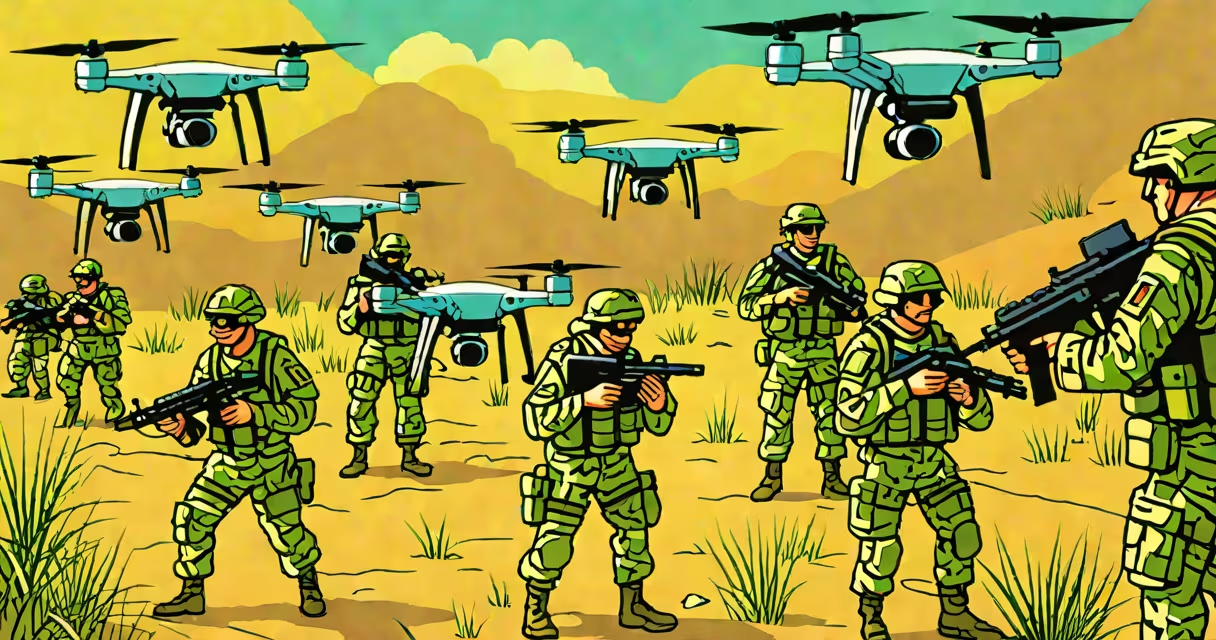
Defense technology training equips military and security personnel with the skills to operate, maintain, and defend against advanced technological systems used in modern warfare, including artificial intelligence, cyber defense platforms, and precision-guided weapons.
This training integrates hands-on exercises with theoretical instruction in electronics, software systems, and threat response protocols. It ensures operators understand both the capabilities and limitations of equipment under real-world conditions.
Programs are delivered through military academies, government agencies like the U.S. Department of Defense's Defense Advanced Research Projects Agency (DARPA), and contracted private institutions. Training duration varies from weeks to years depending on specialization.
Training begins with foundational knowledge in physics, electrical engineering, and computer science. Personnel learn how sensors detect movement, how encryption secures communications, and how algorithms process battlefield data in real time.
Next, trainees engage in simulated environments using virtual reality (VR) and live-fire drills. For example, a drone operator learns to interpret thermal imaging feeds while going through urban terrain under simulated enemy fire. The system tracks reaction times, decision accuracy, and adherence to protocol.
After initial skill acquisition, trainees undergo certification assessments. These include timed scenarios such as identifying and neutralizing a spoofed GPS signal during a convoy mission. Success requires both technical understanding and rapid judgment under pressure.
Different roles require distinct training paths. The table below outlines common categories and their core components:
| Training Type | Core Focus Areas | Duration | Example Application |
|---|---|---|---|
| Cybersecurity operations | Network intrusion detection, malware analysis, secure coding practices | 6-12 months | Defending command centers from state-sponsored hacking attempts |
| Unmanned systems operation | Drone piloting, sensor interpretation, remote control ethics | 8-16 weeks | Reconnaissance missions in conflict zones using armed drones |
| Electronic warfare | Signal jamming, frequency hopping, radar deception techniques | 12-24 months | Disrupting enemy communication during amphibious landings |
| AI-assisted targeting | Machine learning model validation, bias detection, human-in-the-loop oversight | 10-18 months | Using AI to identify high-value targets in complex urban environments |
Each program includes scenario-based evaluations. Trainees must achieve minimum performance thresholds across multiple metrics, such as response latency and false positive rates, before receiving clearance.
Defense technology training is deployed globally by NATO, the European Union's Common Security and Defence Policy (CSDP), and individual nations' armed forces. The U.S. Army's Cyber Center of Excellence at Fort Gordon trains over 5,000 personnel annually in cyber defense tactics.
Without this training, even the most advanced weapon systems fail. A 2022 report by the Congressional Research Service noted that 37% of failed drone missions in Afghanistan were due to operator error, not hardware failure. Proper training reduces such risks by improving situational awareness and reducing cognitive load during high-stress events.
For example, during Operation Inherent Resolve in Iraq, coalition forces relied heavily on AI-powered surveillance drones. Operators trained in anomaly detection identified a hidden tunnel network beneath a rebel stronghold. This led to a successful raid that disrupted supply lines and captured key figures.
Many assume defense technology training is purely technical-focused only on coding or wiring. But it includes psychological resilience, ethical decision-making, and cross-cultural communication. A soldier operating a facial recognition system in a foreign city must understand local norms to avoid civilian harm.
Another misconception is that training ends after graduation. In reality, continuous learning is required. The U.S. Air Force mandates annual recertification for all pilots using advanced avionics. Systems evolve rapidly; a pilot trained in 2020 may face new threats in 2024 that weren't anticipated during initial training.
A lesser-known fact: some training modules are reverse-engineered from adversarial attacks. After a foreign nation successfully infiltrated a U.S. military network in 2019, the Pentagon created a "red team" simulation based on that breach. The resulting training module now teaches recruits to recognize subtle signs of infiltration, such as unusual data packet timing.
I once observed a live drill at Fort Bliss, Texas, where a group of soldiers operated a mobile radar range during a simulated chemical attack. The system detected a false alarm caused by atmospheric interference. Only those who had completed the full environmental calibration course recognized the anomaly and prevented a premature evacuation. That moment confirmed that training isn't about memorizing procedures-it's about building intuition under stress.
Defense technology training is not a one-time event. It is a layered, evolving process that blends technical mastery with operational judgment. Its effectiveness determines whether advanced systems improve readiness or become liabilities in the field.
Understanding how these programs function reveals why nations invest billions annually in them. They are not just about operating machines-they are about safeguarding lives, infrastructure, and strategic advantage in an era where technology defines the battlefield.